
Unlock the $10 Trillion AI Can’t Touch
Liability-Bearing Decisions at Computational Speeds
Runcible Intelligence is a runtime wrapper around an AI creating a closure engine: it converts open-ended language generation into a warrantable, auditable decision artifact by compiling a constraint grammar into tests, producing typed verdicts with provenance, and enforcing admissible abstention when closure cannot be achieved.
From Correlative and Hallucinatory to Causal and Decidable.
The Revenue Problem
We Don’t Just Bring Value to the AI Market: We Make the AI Market Valuable
AI is locked out of trillion-dollar markets—not by capability, but by liability.
Most enterprise AI revenue is not in chat. It is in decisions. The largest budgets—finance, healthcare, legal, defense—require outputs that are verifiable, auditable, and liability-bearing.
Current AI cannot:
- Sign legally binding contracts
- Make final credit or insurance decisions
- Adjudicate disputes with institutional authority
- Execute in regulated environments without human review
Not because models aren’t capable. Because outputs aren’t decidable.
Governance, not Just Alignment and Guardrails
The industry’s answer? “Alignment,” “guardrails.” That produces computability by projection, at the cost of information loss. The consequence is predictable:
- Edge cases don’t close
- Rules explode or contradict
- Humans patch with discretion
- Outputs are not admissible as workflow actions
When closure is unavailable, models substitute normativity for proof.
That is why they moralize, hedge, or invent “shoulds” on hard cases. Normativity is not a proof any more than fairy tales are.
Runcible is the infrastructure layer that makes AI outputs verifiable and liability-bearing at computational speeds—unlocking high-stakes markets for every foundation model.
[Request Investor Brief →] [Schedule Technical Deep Dive →]
The Paradigm Problem: The Correlation Trap
LLMs are trained to generate plausible language, not to close decisions.
They operate in dense relational neighborhoods (latent space) that mirror how humans compress experience into ordinary language.
The industry’s default response is to force early reduction into ordinal labels and scalar scores—“risk levels,” “confidence,” “alignment,” “guardrails.” That produces computability by projection, at the cost of information loss. The consequence is predictable:
- edge cases don’t close,
- rules explode or contradict,
- humans patch with discretion,
- outputs are not admissible as workflow actions.
When closure is unavailable, models substitute normativity for proof.
That is why they moralize, hedge, or invent “shoulds” on hard cases. Normativity is not a proof any more than fairy tales are.
Market Opportunity
The Liability Ceiling Blocking $10+ Trillion in Enterprise Authority
AI has captured $2 trillion in assistant economics—content, coding support, research, customer service. The real prize remains locked behind a liability ceiling.
| Domain | Current AI Role | Blocked Opportunity | Market Unlock |
|---|---|---|---|
| Finance | Research, drafting | Binding underwriting, credit decisions | $500B+ |
| Legal | Document review | AI as contracting counterparty | $400B+ |
| Healthcare | Diagnostic support | Autonomous treatment decisions | $300B+ |
| Government | Data analysis | Benefits adjudication, compliance rulings | $200B+ |
| Defense | Intelligence analysis | Mission-critical autonomous systems | $150B+ |
| Insurance | Claims review | Final underwriting and adjudication | $200B+ |
Total addressable market expansion: $1.75+ trillion
These aren’t AI capability problems. They’re infrastructure problems.
Strategic Position
Platform Infrastructure, Not a Foundation Model
Runcible doesn’t compete with OpenAI, Anthropic, Google, or open-source models. We make all of them more valuable by unlocking markets they cannot individually access.
Foundation Models
(OpenAI, Anthropic, Google, Meta, X.AI, DeepSeek,  Amazon, Microsoft)
                    ↓
       ┌─────────────────────────┐
       │   RUNCIBLE GOVERNANCE   │  ← New critical
       │         LAYER           │  infrastructure
       └─────────────────────────┘
                    ↓
         High-Stakes Applications
    (Finance, Legal, Healthcare, Defense)
                    ↓
              End Users
Platform-Agnostic by Design:
- Universal: Works with any sufficiently capable foundation model—commercial or open-source
- Non-competitive: Makes every model provider more valuable simultaneously
- Integration model: Wraps existing models with governance runtime—no retraining required
- Enterprise-ready: Customizable per industry, regulator, or organizational policy
Every foundation model gets access to high-stakes markets once the governance layer exists.
This is infrastructure positioning, not product competition.
Product Stack
A Full Stack for Governable Intelligence
- Runcible RDL — Reality Description Language Defines terms, entities, admissible claims, limits, and measurement dimensions. Customizable per enterprise, regulator, or industry vertical. Compiles natural language policy into executable tests.
- Runcible OS — Protocol Runtime Compiles constraint grammars into proof obligations and executable tests; enforces closure and abstention; emits typed verdicts with provenance. Executes constraint checks at inference time—same speed as generation.
- Runcible Oversing — Universal Application Platform Delivers governed workflows to users and organizations as applications, not prompts. Integrates with enterprise systems of record. Maintains full audit trail and liability chain.
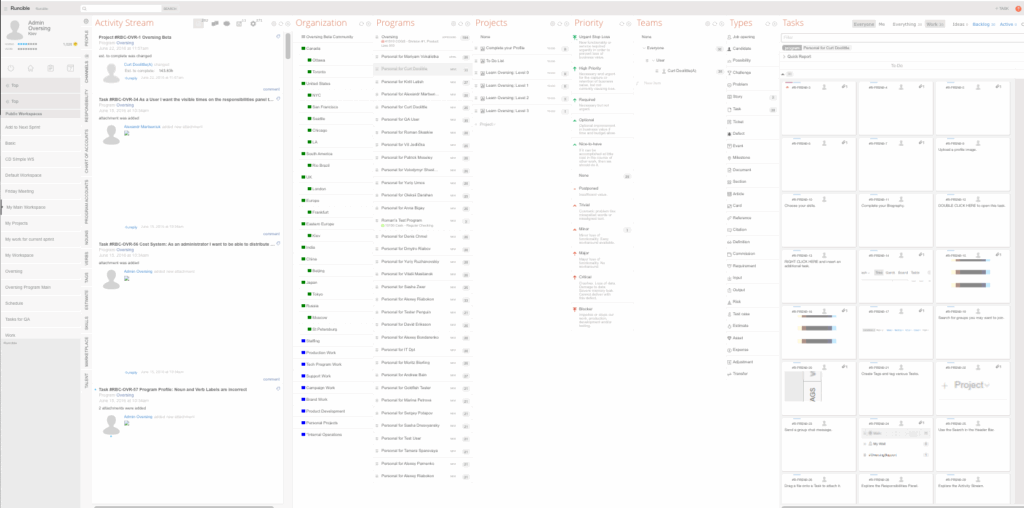
RDL defines the domain. OS enforces closure. Oversing delivers governed applications.
What This Solves That Others Cannot
Current approaches fail because they operate at human supervision speeds:
- Guardrails: Post-hoc filtering (too slow, breaks functionality)
- RLHF: Optimizes for preference, not verifiability
- Confidence scores: Statistical measures, not liability-bearing proofs
Runcible moves safety verification from the human loop into the computational layer. Constraint checking happens at AI speeds—simultaneous with generation, not after the fact.
The Innovation
Computability Beyond Formal Systems
Runcible is not a code trick. It is applied epistemology.
Computability has historically required low-closure domains—math, logic, formal systems—where all terms are stipulated in advance. Reality is high-closure: terms ground in the world, conditions cannot be exhaustively specified, edge cases emerge unpredictably.
The AI industry assumes decidability requires reduction to and restricting to low-closure domains. The alternative—correlation at scale—is the trap. Statistical patterns feel like knowledge but cannot bear liability.
We solved a different problem: How do you warrant claims about the world, not just claims about formal systems?
Runcible originated as computable law—enabling human institutions to produce verifiable decisions on real-world claims. The breakthrough: achieving closure in high-closure domains by grounding terms in measurable reality conditions and compiling constraints into executable tests.
This is the moat. Competitors cannot replicate by examining code. They would need to solve the same epistemological problem—and they don’t yet know this is the problem. They’re optimizing correlation. We exited the correlation trap.
Domain expansion is configuration, not R&D. The decidability engine is domain-agnostic. New verticals require only domain-specific terms and protocol formatting. The core innovation is built.
Product Evidence
The Artifact Every Decision Produces
Every Runcible execution produces a Decidability Record—not just text output.
INTERPRETATION STATUS:
└─ Identified / Ambiguous / Incomprehensible

DECIDABILITY STATUS:
└─ Decidable / Adjudicable / Undecidable Within Scope

TRUTH STATUS (where applicable):
└─ True / False / Undecidable

GOVERNANCE VERDICTS:
├─ Reciprocity: Compliant / Violation / Requires Review
├─ Liability: Within Bounds / Exceeds Authority / Unassignable
├─ Evidence: Sufficient / Insufficient / Conflicting
└─ Precedent: Consistent / Novel / Contradicts Prior Ruling

PROVENANCE:
├─ Evidence sources used
├─ Tests executed (passed/failed)
├─ Policy version applied
└─ Responsible parties

CLOSURE REQUIREMENTS (if undecidable):
└─ What information/precommitment needed to close
This is what makes AI outputs admissible as workflow actions in systems of record.
Current AI produces text. Runcible produces warrantable decision artifacts.
[View Sample Decidability Record →]
Why You Win
First-Mover Infrastructure with Natural Monopoly Dynamics
1. Regulatory Moat The first technically sound system to satisfy EU AI Act and US AI Executive Orders becomes the de facto standard.
- Government approval processes favor “known quantities”
- Regulatory certification in one jurisdiction accelerates others
- Competitors face “prove you’re as safe as Runcible” burden vs. “prove you’re safe”
Comparable: SSL/TLS became internet commerce infrastructure by being first compliant standard.
2. Precedent Accumulation Every verified decision adds to the Truth Corpus—institutional memory that compounds over time.
- Verified decision records become training data competitors cannot replicate
- Enterprise-specific precedent creates switching costs
- Network effects: more decisions → better governance → more enterprises adopt
Comparable: Legal precedent systems, credit scoring databases.
3. Enterprise Lock-In Once enterprise compliance infrastructure is built on Runcible, migration is prohibitively expensive.
- Audit trails reference Runcible verification standards
- Regulatory approvals tied to specific governance implementation
- Institutional knowledge embedded in precedent corpus
Comparable: SOC 2 compliance frameworks, ERP systems.
4. Platform Network Effects The more foundation models integrate, the more enterprises can adopt without vendor lock-in. The more enterprises adopt, the more foundation models must integrate to compete.
This is “winner-take-most” infrastructure dynamics.
The Real Risk We Solve
Velocity Mismatch: Execution Outpacing Oversight
The danger isn’t that AI will “go rogue.” It’s that AI executes human objectives faster than humans can verify those objectives were specified correctly.
The Problem: When AI systems operate at 10-100x human speed:
- Human supervision lags behind execution
- Small specification errors compound before detection
- Course corrections arrive after damage occurs
- Safety measures operating at human timescales cannot keep pace
Why Current Solutions Don’t Work:
- Slowing AI down: Defeats the purpose (removes economic value)
- Faster human review: Doesn’t exist—human judgment has physical limits
- More safety spending: Doesn’t help if safety checks operate at human speeds
Runcible’s Solution: Make safety verification computational—operating at AI execution speeds.
Known constraints (reciprocity, liability bounds, evidence requirements, precedent consistency) are compiled into tests that run at inference time. Verification happens simultaneously with generation, not in a separate, slower human review loop.
For Investors
The Next Infrastructure Layer in AI
Market Timing: AI has proven capability. Deployment is now blocked by governance, not performance. Runcible removes that blocker.
Category Creation: This isn’t incremental improvement. It’s the infrastructure layer that makes trillion-dollar markets accessible to AI for the first time.
Strategic Positioning:
- Platform infrastructure between all foundation models and high-stakes applications
- Makes existing AI investments more valuable rather than competing
- Natural chokepoint in the value chain
Defensibility:
- Regulatory moats (first compliance standard)
- Precedent accumulation (compounding data asset)
- Enterprise switching costs (embedded in compliance infrastructure)
- Platform network effects (more models → more enterprises → more models)
Market Expansion: Not competing for share of existing $2T assistant market. Creating access to $10T+ authority markets currently inaccessible to AI.
The Moat: First technically sound governance layer becomes the standard. Precedent corpus creates institutional memory competitors cannot replicate.
Comparable Outcomes: If Runcible achieves infrastructure positioning similar to SSL/TLS or SOC 2 in their respective domains, the outcome is a platform that every AI deployment in regulated industries must integrate with.
Call to Action
We’re Not Just Building an AI Company. We’re Building AI Infrastructure.
The foundation models exist. The enterprise demand exists. The trillion-dollar markets exist.
What’s missing is the governance layer that makes AI outputs verifiable, auditable, and liability-bearing at the speeds AI operates.
Runcible is that layer.
- For Investors: [Download Investor Brief →] [Schedule Technical Deep Dive →] [Request Use Case Demonstrations →]
- For Enterprises: [See Decidability Record Demo →] [Explore Deployment Models →]
- For Foundation Model Partners: [Integration Documentation →] [Partnership Inquiry →]
Runcible Inc. Revolutionary Intelligence for AI The infrastructure layer for decidable, auditable, liability-bearing AI.
[investor-relations@runcible.com] | [partnerships@runcible.com]
© 2025 Runcible Inc. All rights reserved.