
LLMs solve the hypothesis-supply problem. Runcible solves the hypothesis-selection problem.
The Innovation
Computability Beyond Formal Systems
Runcible is not a code trick. It is applied epistemology.
Computability has historically required low-closure domains—math, logic, formal systems—where all terms are stipulated in advance. Reality is high-closure: terms ground in the world, conditions cannot be exhaustively specified, edge cases emerge unpredictably.
The AI industry assumes decidability requires reduction to and restricting to low-closure domains. The alternative—correlation at scale—is the trap. Statistical patterns feel like knowledge but cannot bear liability.
We solved a different problem: How do you warrant claims about the world, not just claims about formal systems?
Runcible originated as computable law—enabling human institutions to produce verifiable decisions on real-world claims. The breakthrough: achieving closure in high-closure domains by grounding terms in measurable reality conditions and compiling constraints into executable tests.
This is the moat. Competitors cannot replicate by examining code. They would need to solve the same epistemological problem—and they don’t yet know this is the problem. They’re optimizing correlation. We exited the correlation trap.
Domain expansion is configuration, not R&D. The decidability engine is domain-agnostic. New verticals require only domain-specific terms and protocol formatting. The core innovation is built.
Building out decidability in the 30+ industrial and political verticals is a matter of manpower and months, not years.
The Problem Is Closure
Mathematics and programming obtain closure by narrowing reality.
Mathematics closes by axiom, definition, operation, and derivation. Programming closes by syntax, type, compilation, and execution. Both work because their objects are stipulated, their operations are specified, and their transformations are rule-governed.
That kind of closure is powerful.
But it is purchased by exclusion.
Formal systems obtain certainty by leaving most of reality outside the grammar.
Institutional action cannot do that.
Institutions act in open-world conditions: incomplete evidence, ambiguous terms, changing context, conflicting rules, unclear authority, externalities, and liability.
So the problem Runcible solves is not merely how to make AI produce better answers.
The problem is how to obtain sufficient closure for action in domains where natural language, evidence, authority, and liability cannot be reduced to ordinary programming closure.
That is the institutional AI problem.
Natural Language Uses Natural Indexes
Ordinary language does not operate with stipulated symbols alone.
Words are natural indexes.
A term such as “trust,” “property,” “harm,” “right,” “authority,” “responsibility,” “risk,” “truth,” or “institution” does not close by definition alone. It points into a network of referents, relations, uses, contexts, operations, expectations, costs, falsifiers, enforcements, and liabilities.
This is why natural language is so powerful.
It indexes reality.
It is also why natural language is dangerous.
It lacks formal closure.
A sentence may be grammatical, plausible, and useful while still failing to bind its referents, define its scale, identify its operation, satisfy evidence, survive falsification, or remain within liability.
That is why institutional AI cannot depend on fluency alone.
Fluency can produce a sentence.
It cannot produce warrant.
LLMs Produce Candidate Closure Over Natural Indexes
LLMs are useful because they operate over natural indexes at scale.
They perform probabilistic accounting over linguistic use, context, relation, expectation, and constraint.
Given a context, they can supply candidate meanings, relations, classifications, explanations, analogies, and actions that satisfy the local semantic demand.
This is not failure.
This is their power.
But the result is candidate closure, not institutional closure.
The model can propose what relation best fits the context.
It cannot, by generation alone, prove that the relation is true, permitted, possible, and within liability.
That is where Runcible begins.
The Cognitive Analogy
The best functional analogy is not “AI as judge.”
It is closer to associative memory.
LLMs behave like large-scale associative systems: they complete patterns, recover frames, interpolate meanings, reconstruct missing relations, compress experience into language, and generate candidate hypotheses.
That is similar in function to hippocampal auto-associative memory, though not in biological implementation.
But institutional action requires another function.
It requires something closer to prefrontal executive control: inhibition, sequencing, conflict detection, counterfactual testing, operational reduction, consequence evaluation, authority checking, liability assignment, and withholding judgment when closure is absent.
Current AI practice often tries to force the associative function to perform the executive function.
That is like asking memory to become judgment by remembering harder.
Runcible separates the functions.
The LLM supplies candidate meaning.
RDL makes candidate meaning operationally expressible.
Runcible recursively tests whether the candidate survives.
The Decidability Record preserves what survived, what failed, what was repaired, and what remains undecidable.
The Correlation Trap
The correlation trap is the error of treating a system optimized for associative completion as if it were also sufficient for testing, falsifying, bounding, warranting, and authorizing the claims produced by that completion.
Attention made correlation discovery and semantic completion extraordinarily powerful.
Because that innovation worked, the industry tried to use the same architecture for almost everything:
- retrieval,
- reasoning,
- judgment,
- truth,
- safety,
- planning,
- authority,
- institutional action,
- and liability.
But generation and adjudication are different operations.
A system that completes patterns is not therefore a system that warrants testimony.
A system that supplies plausible continuations is not therefore a system that produces institutional closure.
A system that generates hypotheses is not therefore a court, compiler, auditor, scientist, or responsible agent.
The correlation trap mistakes associative completion for adjudicated knowledge.
Runcible avoids that trap by separating the functions.
The model supplies candidate meaning.
RDL makes candidate meaning testable.
Runcible determines whether it survives.
The Decidability Record preserves the result.
Hallucination Is Not the Flaw. Unadjudicated Hallucination Is the Flaw.
“Hallucination” is a misleading term because it pathologizes a necessary function.
A better description is:
associative overextension
or:
unadjudicated reconstruction
An LLM receives partial cues and completes them into plausible semantic wholes.
Humans do the same thing.
Memory is reconstructive. We complete fragments, infer relations, normalize events into stories, extend patterns, and propose possible causes.
This is not a defect of intelligence.
It is one of intelligence’s generative capacities.
The problem is not reconstruction.
The problem is reconstruction without correction.
Human cognition requires correction:
- perception corrects memory,
- action corrects prediction,
- other people correct testimony,
- science corrects explanation,
- law corrects accusation,
- markets correct valuation,
- institutions correct disputes.
Current AI deployment often gives us reconstruction without sufficient correction.
That is the failure.
Runcible does not try to eliminate hypothesis generation.
It makes hypothesis generation institutionally usable by subjecting it to recursive testing, repair, falsification, and decidability.
The short version:
Hallucination is not the flaw. Unadjudicated hallucination is the flaw.
LLMs Solve Hypothesis Supply
Before LLMs, the cost of producing candidate semantic constructions was high.
Humans had to supply the analogy, classification, explanation, possible cause, possible rule, possible decision, possible action, or possible synthesis.
LLMs changed that.
They make hypothesis supply cheap.
They can supply:
- candidate meanings,
- candidate explanations,
- candidate classifications,
- candidate analogies,
- candidate causal chains,
- candidate summaries,
- candidate plans,
- candidate decisions,
- candidate actions,
- candidate repairs,
- candidate generalizations.
This is the actual breakthrough.
The model is not merely a better search interface.
It is a generator of candidate semantic relations across natural language.
But candidate supply creates a new bottleneck.
When hypotheses become cheap, selection becomes the scarce function.
When semantic supply becomes abundant, adjudication becomes the constraint.
That is where Runcible enters.
Institutions Need Hypothesis Selection
Institutions cannot act on candidate meaning.
They require adjudicated claims.
Before an institution acts, it must know:
- What is the claim?
- What are the terms?
- What referents are bound?
- What operation is asserted?
- What scale is being used?
- What evidence supports it?
- What would falsify it?
- What rule permits or prohibits it?
- Who has authority?
- What externalities follow?
- Who bears liability?
- What remains undecidable?
This is not primarily a generation problem.
It is a selection problem.
It is a wayfinding problem.
It is an adjudication problem.
The industry has often tried to solve this by making the generator better: larger models, longer context, more retrieval, more prompt engineering, more guardrails, more post-hoc filters.
Those help.
They do not solve the category problem.
The category problem is that a hypothesis engine is being used as if it were already a judgment engine.
Runcible solves the other half of the architecture.
RDL Makes Candidate Meaning Testable
Natural language is powerful because it indexes reality.
But it lacks formal closure.
Words such as “truth,” “harm,” “property,” “authority,” “responsibility,” “right,” “risk,” “liability,” and “institution” are not closed by definition alone. They are natural indexes into networks of referents, relations, operations, contexts, consequences, obligations, and enforcement conditions.
LLMs operate over those natural indexes.
They can produce candidate semantic closure.
But plausibility is not warrant.
RDL exists to convert candidate semantic material into typed operational form.
RDL supplies:
- typed terms,
- referent binding,
- canonical positions,
- scale assignments,
- permitted relations,
- operation identification,
- scope boundaries,
- evidence requirements,
- falsifiers,
- reciprocity tests,
- liability boundaries,
- decidability states.
This is the compiler boundary.
Natural-language output is not yet institutionally testable.
RDL makes it testable.
The strongest technical analogy is:
RDL is the compiler boundary between probabilistic semantic generation and institutional adjudication.
Or more compactly:
RDL turns probabilistic semantic supply into testable operational claims.
Runcible Supplies Recursive Adjudication
Once a candidate claim has been expressed in testable form, Runcible adjudicates it.
The canonical sequence is:
Associative completion → candidate hypothesis → RDL translation → term binding → type checking → scale checking → operational reduction → adversarial testing → reciprocity / liability testing → pass / fail / repair / undecidable
This is the artificial executive layer.
The LLM supplies associative completion.
RDL converts that completion into operational expression.
Runcible tests whether the expression survives.
The process is recursive because open-world claims rarely close in one pass.
A candidate may fail because evidence is missing.
It may fail because a term is ambiguous.
It may fail because a scale jump is unlicensed.
It may fail because the asserted operation is impossible.
It may fail because the rule does not permit the action.
It may fail because liability cannot be bounded.
A weaker system says:
wrong
or:
try again
or:
here is a safer answer
Runcible asks:
Why did it fail?
What kind of failure occurred?
What repair is possible?
What remains undecidable?
What must be supplied before action can be authorized?
That is why the recursive stack matters.
It is not prompt engineering.
It is scientific method, compiler discipline, legal adversarialism, and institutional warrantability expressed as procedure.
The Method Is Evolutionary, Not Merely Justificationary
Mathematics, programming, and much of formal logic obtain closure inside artificial high-closure grammars.
They close by stipulation:
- defined objects,
- specified operations,
- bounded syntax,
- formal rules,
- derivation,
- compilation,
- execution.
This is powerful because the grammar excludes most of reality.
Natural language and institutional action do not have that luxury.
They must operate in open-world conditions: incomplete evidence, ambiguous terms, changing contexts, conflicting rules, unclear authority, externalities, and liability.
So Runcible does not rely on justification alone.
It uses construction and selection.
The positive path constructs the claim:
- identity,
- definition,
- relation,
- operation,
- scale,
- causal mechanism,
- evidence requirement.
The negative path tests the claim:
- ambiguity,
- contradiction,
- missing referent,
- wrong type,
- wrong scale,
- operational impossibility,
- external non-correspondence,
- counterexample,
- falsifier,
- reciprocity violation,
- liability overrun.
Truthfulness is not asserted by the construction.
Truthfulness is retained by survival.
The method is evolutionary:
variation → selection → retention
In Runcible terms:
candidate claim → adversarial testing → retained testimony
Or:
semantic supply → constraint demand → surviving meaning
That is why Runcible is not merely falsificationary and not merely justificationary.
It is constructive enough to make a claim testable and adversarial enough to prevent the claim from escaping correction.
False Hypotheses Are Not Waste
A false hypothesis is not merely noise.
It is an experimental result.
It tells the system that a candidate relation failed some constraint.
The value appears when the system can locate the failure.
Was the claim false because it was:
- unsupported,
- contradicted,
- ambiguous,
- wrong type,
- wrong scale,
- missing an operation,
- impossible,
- overgeneralized,
- externally inconsistent,
- irreciprocal,
- outside authority,
- or beyond liability warrant?
Each failure type implies a different repair path.
A flat category of “wrong” is not enough.
Runcible treats wrongness as a diagnostic tree.
That is essential because falsehood becomes useful only when its cause is made testifiable.
A false hypothesis is the search cost of discovering a more testifiable one.
The cost is wasted only when the system fails to record why the candidate failed.
This is one of Runcible’s most important differences from ordinary AI systems.
It does not merely suppress error.
It classifies error.
It uses error to repair claims, expose missing evidence, improve protocols, and prevent premature institutional action.
The Command Stack Is Scientific Method Mechanized
Runcible’s recursive command stack is not an implementation detail.
It is the epistemology embodied as procedure.
The pattern is:
generate candidate → construct claim → bind terms → assign scale → reduce to operations → identify tests → run adversarial checks → classify failures → repair claim → repeat until pass, fail, or undecidable
This is scientific method in operational form.
It is also legal method in operational form.
It is also economic method in operational form.
Science works by constructing hypotheses, exposing them to test, retaining what survives, and revising what fails.
Law works by presenting claims, binding parties, applying rules, admitting evidence, challenging testimony, assigning responsibility, and retaining judgments that survive procedure.
Markets work by supplying offers, imposing demand, pricing constraints, clearing trades, and punishing failed expectations.
Runcible applies this same architecture to semantic claims produced by AI.
The model supplies the candidate.
RDL denominates the candidate.
Runcible tests the candidate.
Decidability clears or refuses the candidate for action.
The Decidability Record preserves the result.
The Economic Logic of Semantic Closure
The economic analogy is not decorative.
It explains why the architecture works.
In markets:
- supply offers possible goods,
- demand imposes selection pressure,
- price communicates scarcity, utility, and constraint,
- failed trades reveal mispriced expectations,
- clearing determines what can proceed.
In semantic reasoning:
- speech supplies possible meanings,
- LLMs supply candidate generalizations,
- context demands disambiguation,
- evidence prices claims,
- falsifiers impose cost,
- reciprocity limits permissible action,
- liability prices institutional use,
- decidability clears or refuses the claim.
So the architecture is:
LLM generation = semantic supply
RDL = denomination and measurement
Runcible testing = demand, price, and constraint
failure = failed trade / failed experiment
decidability = clearing condition
Decidability Record = accounting ledger
This is why Runcible fits institutional AI.
Institutions cannot operate on semantic supply alone.
They require clearing.
Decidability is the clearing condition under which testimony may be acted upon.
Runcible Turns Associative Overextension Into Governed Discovery
Most attempts to reduce hallucination try to suppress the model’s generative faculty.
Runcible does something different.
It preserves hypothesis generation, then adds adjudication.
That matters because discovery requires overproduction of candidates.
Action requires selection.
A system optimized only to avoid error becomes conservative, evasive, and incomplete.
A system optimized only to generate becomes plausible, creative, and dangerous.
Runcible separates the functions.
The model is allowed to supply candidate meaning.
RDL forces candidate meaning into testable form.
Runcible determines whether it survives.
The Decidability Record preserves survival, failure, repair, or undecidability.
This turns associative overextension from liability into experimental variation.
The question is not:
How do we prevent the model from ever being wrong?
The better question is:
How do we make wrongness informative, correctable, bounded, and non-actionable until repaired?
That is the superior architecture for open-world institutional use.
Why This Matters for Institutional AI
Assistant AI can tolerate unresolved ambiguity.
Institutional AI cannot.
A person can use an AI answer as a suggestion, inspiration, draft, or prompt for further thought.
An institution cannot treat that same answer as an authorized action unless it has been tested, reviewed, bounded, and recorded.
That is why assistant AI and institutional AI require different architectures.
Assistant AI optimizes for useful output.
Institutional AI requires adjudicated actionability.
The relevant question is not:
Did the model produce a good answer?
The relevant question is:
Can the institution act on this claim or proposed action, under this evidence, these rules, this authority, and this liability boundary?
Runcible is built for that question.
Closing on Closure
LLMs made semantic hypothesis generation abundant.
Runcible makes semantic hypothesis selection accountable.
- Natural language supplies open-world meaning through natural indexes.
- LLMs generate candidate closures over those indexes.
- Runcible RDL converts candidate closure into typed operational claims.
Runcible recursively tests those claims for identity, operation, evidence, reciprocity, liability, and decidability.
The Decidability Record preserves what survived, what failed, why it failed, what was repaired, and what remains undecidable.
That is why Runcible is not merely a better wrapper around an LLM.
- It is a different epistemic architecture.
- It separates generation from adjudication.
- It converts associative completion into testable claims.
- It converts falsehood into diagnostic information.
- It converts recursive testing into institutional memory.
- And it converts probabilistic semantic supply into action-ready institutional records.
That is how AI moves from assistant output to institutional action.
See the Technical Architecture
View Sample Decidability Record
Request Investor Brief
Short Version: Mathematics and programming achieve closure by narrowing reality into stipulated, high-closure grammars. LLMs operate over natural indexes, using probabilistic accounting to supply candidate semantic closures. Runcible, through RDL, converts those candidate closures into typed operational claims and subjects them to constructive and adversarial testing. The method therefore inverts the justificationary proof model: truthfulness is not produced by derivation alone, but by Darwinian competition between via positiva construction and via negativa falsification. In effect, Runcible applies supply-demand logic to semantic generalization: the model supplies candidate meaning; reality, evidence, reciprocity, and liability impose demand – decidability is the clearing condition.
Full Version: Mathematics and programming obtain closure inside artificial high-closure grammars by means of cardinal and ordinal indexing, stipulated definitions, formal operations, and rule-bound transformations. Natural language, by contrast, operates through natural indexes: terms are positional names within networks of referents, relations, operations, contexts, and consequences.
LLMs are useful because they perform probabilistic accounting across these natural indexes. They can supply candidate semantic closures by estimating which meanings, relations, and continuations best satisfy the contextual demand. But this produces plausibility, not warrant.
Runcible, using RDL, attempts to convert that probabilistic semantic supply into typed operational claims that can be tested. In this sense, RDL inverts the justificationary proof model of mathematics, programming, and formal logic. It does not seek closure by derivation from stipulated axioms alone. It constructs a claim through the via positiva, then subjects that construction to the via negativa of falsification, adversarial testing, reciprocity, and liability.
The result is Darwinian competition between constructed explanations and falsifying constraints. Truthfulness is not asserted by justification. It is retained by survival.
In this sense, Runcible applies supply-demand logic from economics to semantic generalization: candidate meanings are supplied by probabilistic inference; demand is imposed by reality, evidence, operation, reciprocity, and liability; and decidability is the clearing condition under which testimony may be acted upon.
Liability-Bearing Decisions at Computational Speeds
Runcible Intelligence is a runtime wrapper around an AI creating a closure engine: it converts open-ended language generation into a warrantable, auditable decision artifact by compiling a constraint grammar into tests, producing typed verdicts with provenance, and enforcing admissible abstention when closure cannot be achieved.
From Correlative and Hallucinatory to Causal and Decidable.
The Paradigm Problem: The Correlation Trap
LLMs are trained to generate plausible language, not to close decisions.
They operate in dense relational neighborhoods (latent space) that mirror how humans compress experience into ordinary language.
The industry’s default response is to force early reduction into ordinal labels and scalar scores—“risk levels,” “confidence,” “alignment,” “guardrails.” That produces computability by projection, at the cost of information loss. The consequence is predictable:
- edge cases don’t close,
- rules explode or contradict,
- humans patch with discretion,
- outputs are not admissible as workflow actions.
When closure is unavailable, models substitute normativity for proof.
That is why they moralize, hedge, or invent “shoulds” on hard cases. Normativity is not a proof any more than fairy tales are.
Strategic Position
Platform Infrastructure, Not a Foundation Model
Runcible doesn’t compete with OpenAI, Anthropic, Google, or open-source models. We make all of them more valuable by unlocking markets they cannot individually access.
Foundation Models
(OpenAI, Anthropic, Google, Meta, X.AI, DeepSeek,  Amazon, Microsoft)
                    ↓
       ┌─────────────────────────┐
       │   RUNCIBLE GOVERNANCE   │  ← New critical
       │         LAYER           │  infrastructure
       └─────────────────────────┘
                    ↓
         High-Stakes Applications
    (Finance, Legal, Healthcare, Defense)
                    ↓
              End Users
Platform-Agnostic by Design:
- Universal: Works with any sufficiently capable foundation model—commercial or open-source
- Non-competitive: Makes every model provider more valuable simultaneously
- Integration model: Wraps existing models with governance runtime—no retraining required
- Enterprise-ready: Customizable per industry, regulator, or organizational policy
Every foundation model gets access to high-stakes markets once the governance layer exists.
This is infrastructure positioning, not product competition.
Product Stack
A Full Stack for Governable Intelligence
- Runcible RDL — Reality Description Language Defines terms, entities, admissible claims, limits, and measurement dimensions. Customizable per enterprise, regulator, or industry vertical. Compiles natural language policy into executable tests.
- Runcible OS — Protocol Runtime Compiles constraint grammars into proof obligations and executable tests; enforces closure and abstention; emits typed verdicts with provenance. Executes constraint checks at inference time—same speed as generation.
- Runcible Oversing — Universal Application Platform Delivers governed workflows to users and organizations as applications, not prompts. Integrates with enterprise systems of record. Maintains full audit trail and liability chain.
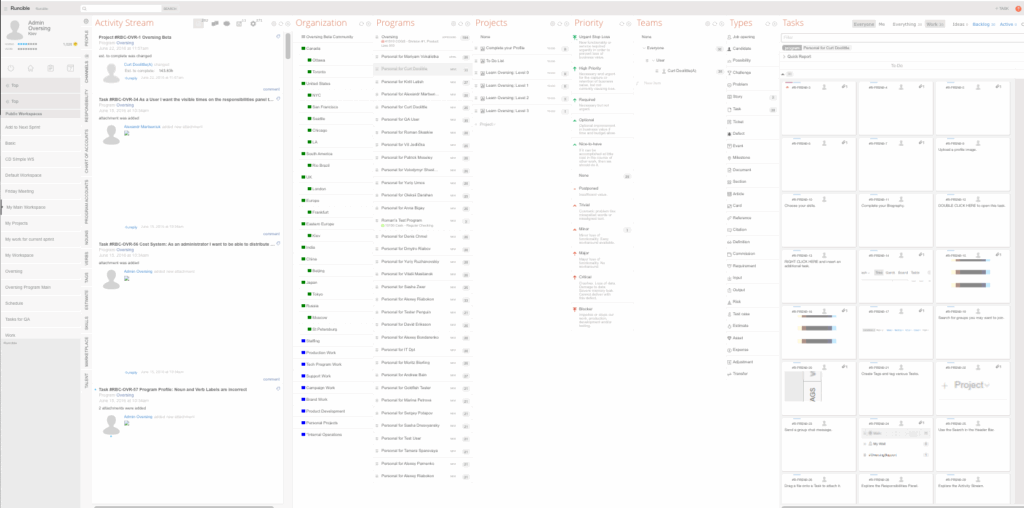
RDL defines the domain. OS enforces closure. Oversing delivers governed applications.
What This Solves That Others Cannot
Current approaches fail because they operate at human supervision speeds:
- Guardrails: Post-hoc filtering (too slow, breaks functionality)
- RLHF: Optimizes for preference, not verifiability
- Confidence scores: Statistical measures, not liability-bearing proofs
Runcible moves safety verification from the human loop into the computational layer. Constraint checking happens at AI speeds—simultaneous with generation, not after the fact.
Runcible Intelligence is a runtime wrapper around an AI AI can draft, summarize, recommend, and assist.
Product Evidence
The Artifact Every Decision Produces
Every Runcible execution produces a Decidability Record—not just text output.
INTERPRETATION STATUS:
└─ Identified / Ambiguous / Incomprehensible

DECIDABILITY STATUS:
└─ Decidable / Adjudicable / Undecidable Within Scope

TRUTH STATUS (where applicable):
└─ True / False / Undecidable

GOVERNANCE VERDICTS:
├─ Reciprocity: Compliant / Violation / Requires Review
├─ Liability: Within Bounds / Exceeds Authority / Unassignable
├─ Evidence: Sufficient / Insufficient / Conflicting
└─ Precedent: Consistent / Novel / Contradicts Prior Ruling

PROVENANCE:
├─ Evidence sources used
├─ Tests executed (passed/failed)
├─ Policy version applied
└─ Responsible parties

CLOSURE REQUIREMENTS (if undecidable):
└─ What information/precommitment needed to close
This is what makes AI outputs admissible as workflow actions in systems of record.
Current AI produces text. Runcible produces warrantable decision artifacts.
[View Sample Decidability Record →]
The Real Risk We Solve
Velocity Mismatch: Execution Outpacing Oversight
The danger isn’t that AI will “go rogue.” It’s that AI executes human objectives faster than humans can verify those objectives were specified correctly.
The Problem: When AI systems operate at 10-100x human speed:
- Human supervision lags behind execution
- Small specification errors compound before detection
- Course corrections arrive after damage occurs
- Safety measures operating at human timescales cannot keep pace
Why Current Solutions Don’t Work:
- Slowing AI down: Defeats the purpose (removes economic value)
- Faster human review: Doesn’t exist—human judgment has physical limits
- More safety spending: Doesn’t help if safety checks operate at human speeds
Runcible’s Solution: Make safety verification computational—operating at AI execution speeds.
Known constraints (reciprocity, liability bounds, evidence requirements, precedent consistency) are compiled into tests that run at inference time. Verification happens simultaneously with generation, not in a separate, slower human review loop.
Runcible Inc. Revolutionary Intelligence for AI The infrastructure layer for decidable, auditable, liability-bearing AI.
[investor-relations@runcible.com] | [partnerships@runcible.com]
© 2025 Runcible Inc. All rights reserved.