
Runcible AI and OS (Oversing): Component Inventory and State of Completion
Historical assessment: 29 July 2026. This inventory preserves the component counts, estimates, and interpretations from that inspection. It is not a current capability report. Read the 26 October capability statement for the current narrative and evidence boundaries.
Assessed 29 July 2026 from direct inspection of 18 repositories under ~/Code, not from status documents. Where a repository’s own status file disagrees with its artifacts, the artifacts win — PROJECT_STATUS_AND_NEXT_STEPS.md stops at 11 April while build output runs to 8 June.
| 83 | 672 | 2 of 10 | 0 |
| Protocol releases compiled and schema-validated | Oversing routes live in production today | Volumes substantially complete | Local-AI components built |
The finding that reframes the question
Runcible AI, the piece we describe as “just one piece of the puzzle” is the piece that is hardest to copy, and it is running in production. The adjudication semantics — ternary logic, decidability, the closure ladder, warranty and liability burdens, 29 verdict blocks — are implemented, schema-gated, and enforced on every request across 83 compiled releases with a validating compiler in front of them.
What is missing is not the thinking. It is substrate (a local model), surface (RDL as an authored language), corpus (Volume 4, then 6 through 10), the join between OS and AI, and a company. Those are a capital problem, a formalization problem, a writing problem, an integration problem, and a hiring problem — and only two of them stand between us and first revenue.
Percentages are judgment against each component’s own finished-state definition, with the evidence for each shown in the tables. Layer figures are unweighted means of their components; treat them as direction, not measurement.
Where the Five Layers Stand
Read this as a shape, not a score. The tall bar is the defensible technology; the short bars are mostly purchasable with capital and time.
Estimated completion by layer
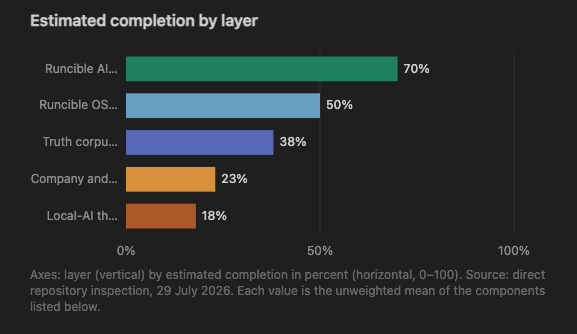
Axes: layer (vertical) by estimated completion in percent (horizontal, 0–100). Source: direct repository inspection, 29 July 2026. Each value is the unweighted mean of the components listed below.
Layer 1 — Runcible AI, as It Actually Runs Today
This is the WordPress interface, the Lambda gateway, the AWS services behind it, and the governed OpenAI layer. It is a real system with a real release pipeline. Its weakness is not capability; it is that it has no automated safety net and no infrastructure definition, so it depends on you.
| Component | State | Complete | Evidence in the repositories |
|---|---|---|---|
| Protocol contract layer | Production | 90% | 11 contracts, 2,558 lines. output_contract.yaml is 1,065 lines at schema v1.4; verdict_enums.yaml is 505 lines covering 29 protocol blocks and 4 scoring tracks. Four result contracts are still marked composed_draft. |
| Compiled protocol runtime | Production | 85% | compiled_protocols.yaml (3,546 lines) expands to a 10,392-line runtime YAML across 22 canonical protocols. One externalities TODO still rides in the shipped runtime. |
| Compiler and release pipeline | Production | 90% | build / verify / release / diff / deploy commands with SHA-256 manifests and JSON Schema gates that exit non-zero on failure. 83 manifests produced; latest core.2026-06-08.03 validates with 0 errors and 0 warnings. |
| AWS Lambda gateway | Production | 80% | 22,369 lines, roughly 100 functions and classes. Passthrough and full artifact modes, contract-repair retries, async self-invoke, Secrets Manager, S3, DynamoDB, optional Bedrock router. Monolithic, and logging is bare print() to CloudWatch. |
| OpenAI hosted layer | Production, with a manual step | 75% | 22 versioned knowledge packs plus prompt and vector-store mapping records. File and vector sync are scripted, but the hosted prompt object body is still pasted into the dashboard by hand — manual_prompt_object_update.txt appears in 12 packs. |
| WordPress chat interface | Working, not hardened | 65% | 978-line plugin plus 2,940-line client. Streaming, async polling, telemetry footer, command composer. But purify.min.js is enqueued and absent from the repo, access is logged-in only, and there is no responsive CSS or ARIA. |
| QA harness | Strong, currently red | 70% | A 2,623-line deterministic contract verifier with about 100 assertions, plus 11 live smoke scripts and a five-mode live matrix. Last recorded all-green was 5 April; 11 routing-regression failure artifacts remain, the newest dated 17 April. |
| CI, infrastructure as code, observability | Missing | 15% | No GitHub Actions or any other CI in the repository. No Terraform, CloudFormation, SAM, or CDK. No dashboards or alarms. Metrics exist only as an ad-hoc profiling script. |
Layer 2 — the Truth Corpus and Domain Coverage
The corpus is what makes the engine say anything worth adjudicating, and it is the most uneven part of the estate. Two volumes carry almost all of the weight.
Retrieval text shipped per volume (thousands of words)
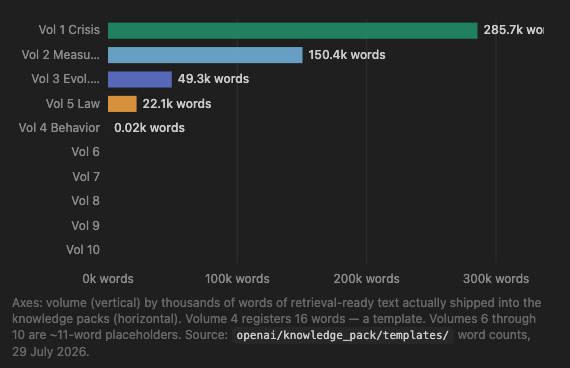
Axes: volume (vertical) by thousands of words of retrieval-ready text actually shipped into the knowledge packs (horizontal). Volume 4 registers 16 words — a template. Volumes 6 through 10 are ~11-word placeholders. Source: openai/knowledge_pack/templates/ word counts, 29 July 2026.
| Component | State | Complete | Evidence in the repositories |
|---|---|---|---|
| Volume 1 — Crisis of the Age | Substantially complete | 90% | 285,724-word retrieval pack generated from 3.68 MB of source text. Manuscript at v11, roughly 123,000 words. |
| Volume 2 — System of Measurement | Substantially complete | 85% | 150,412-word retrieval pack. Manuscript between 140,000 and 153,000 words across synced versions. |
| Volume 3 — Evolutionary Computation | In progress | 55% | 49,277-word pack against a roughly 141,000-word manuscript. RESUME_NOTES.md flags unwritten sections including Finiteness and Space. |
| Volume 4 — Behavior | Not started | 5% | A 3-line, 16-word template. protocol/volumes/vol4_behavior/ is empty and volume_index.yaml records status: missing. |
| Volume 5 — Law | Early draft | 30% | 22,141-word pack — the thinnest of the four volumes actually shipping in the runtime, despite law being the lead domain. |
| Volumes 6 through 10 | Not started | 0% | Five placeholder files of roughly 11 words each. No corresponding source directories. |
| Domain overlays | Partial | 30% | Five namespaces. Health is the deepest at 38 files with a medical adapter and four domain contracts; law has a registry plus 12 test vectors; defense and curation are stubs whose READMEs still read Not Yet Implemented against Q3 2025 targets. |
| Client overlays | Scaffolding only | 10% | One example-client stub with empty add and overrides blocks, existing to exercise stack paths. |
Volume 4 is a structural blocker, not a gap in a list
Behavior sits underneath both law and health. Its absence caps how far any domain overlay can be taken, which is why health stalls at an adapter and law stalls at test vectors. Against the announced ten-volume scope the corpus is about 38 percent complete; against the five volumes the runtime actually loads, about 53 percent. Volume 5 (Law) being the thinnest shipped volume, while law is your lead domain, is worth sitting with.
Layer 3 — Runcible OS (Oversing)
Our argument that Oversing can serve as “a vast context store of a large organization, its people and its processes” is not speculative. It already is one: 236 tables and 672 routes of organizational structure, workflow, finance, people, permissions and documents, in production. The problem is the runtime it sits on and the fact that only one of three trees knows about the AI.
| Component | State | Complete | Evidence in the repositories |
|---|---|---|---|
| Legacy production application | Live, on an end-of-life runtime | 85% | Running at app.runcible.com. 236 database tables, 672 configured routes, 127 controllers, 221 models, 812 views, roughly 195,000 lines of PHP and 990,000 lines of JavaScript. Laravel 4.2 on PHP 5 and Debian Jessie. |
| In-product help guide | Built | 60% | 221 markdown topics published into both application trees, plus a WordPress package of 8 chapters and 223 images. Nine images missing and the public /guide import is still pending. |
| Multi-tenant provisioning | Partial | 50% | Instance licensing and provisioning are done in the live-canon tree. DNS and TLS automation remain open backlog items. |
| RAI integration — the OS to AI join | Partial, one tree only | 45% | Nine Rai* libraries, RaiOrchestratorController, RaiGatewayClient and raiPanel.js exist in oversing-live-canon only. Absent from the main oversing tree and entirely absent from the Laravel 13 harness. |
| Laravel 13 migration | Early harness | 10% | Genuinely good test discipline — 88 test files, 598 tests and 8,367 assertions passing, with CI configured. But roughly 15 to 20 of 672 routes have modern boundaries, which is 2 to 3 percent of the surface, and the last completed slice was help-panel wiring rather than core API work. |
Three trees, one product
The estate holds oversing/ (legacy plus experiments), oversing-live-canon/ (the production snapshot, and the only tree with RAI), and oversing-next/ (the Laravel 13 harness). RAI exists in exactly one of them and the migration harness in another. Any new engineer will lose their first week working out which tree is authoritative — and the migration, while well tested, has covered 2 to 3 percent of the route surface, so it is not on a path to replace anything soon.
Layer 4 — the Local-Ai Thesis: What Does Not Exist Yet
This is the part we are right to flag as unbuilt. But the estimate is not uniformly zero, and the distinction matters a great deal for how we talk about it.
| Component | State | Complete | Evidence in the repositories |
|---|---|---|---|
| Adjudication semantics — what RDL is meant to express | Built, in YAML rather than RDL | 70% | Ternary logic, decidability, the closure ladder, burden classes, warranty and liability gates and 29 verdict blocks are all implemented as schema-validated contracts and enforced on every production request. |
| RDL as a defined public concept | Defined | 40% | Reality Description Language has an owner definition, a five-stage pipeline, and a canonical page at /how-it-works/rdl-compiler/#the-inversion. Your own site audit records it as used four times on How It Works and defined zero times. |
| RDL grammar, parser, compiler | Not started | 0% | No .rdl files, no grammar or EBNF, no parser, lexer or AST anywhere across any of the repositories. Zero matches in code. |
| Local model — substrate independence | Not started | 0% | No local model, weights, serving layer, or inference code in any repository. |
| Training and evaluation pipeline | Not started | 0% | No training code, no datasets assembled for training, no evaluation harness. |
| Truth corpus bound to a local model | Not started | 0% | The corpus is bound to an OpenAI vector store today. That is the only retrieval binding that exists, and it is not portable. |
| Hypothesis-engine runtime | Prototype | 15% | RuncibleCoreAPIv2 implements the claim to ledger to graph to obligations to verifier to Decidability Record path in 17 modules and 853 lines, against a mock model gateway. Not under version control and not wired to production. |
| Oversing as organizational context store | Specified | 15% | RAI_INTEGRATION.md documents the route-parity model — if the logged-in user can do it, RAI may do it. The orchestrator exists; the context-store binding does not. |
RDL is both further along and further from done than it looks
The semantics RDL is meant to express already run. Verdict enumerations, gate booleans, the closure ladder, burden classes, ternary output states — all implemented as contracts and enforced by the gateway on live traffic. What does not exist anywhere in code is RDL as a language: no grammar, no parser, no .rdl file, no compiler. Zero matches across every repository.
The practical consequence is good news: an RDL v0 is a formalization exercise over something that already works, not a design-from-scratch project. You would be giving a surface syntax to a semantics you have already validated in production. The reputational consequence is less comfortable: runcible.com names RDL across five pages, and by your own site audit defines it zero times on How It Works. Right now the language is more present in your marketing than in your codebase, and a technical diligence reader will find that in an afternoon.
Layer 5 — Company and Go-To-Market
“We have done this before” so to speak, but never with AIs. That shows in the shape of this layer: the artifacts a company normally needs a team to produce are unusually far along, and the team is at zero. Materials are not the constraint. People are.
| Component | State | Complete | Evidence in the repositories |
|---|---|---|---|
| Marketing site (runcible.com) | Live and actively maintained | 75% | 39 public URLs with a heading contract applied across 9 pages and edits landing as recently as 29 July. |
| Investor and partner portal | Built, needs review | 65% | Four-layer structure with 18 memo pages restored and decks A through D. The PPTX, PDF and DOCX bodies are still legacy, logged-in QA has not been walked, and two pages are effectively empty. |
| End-user help content | Substantial | 55% | 221 guide topics plus two instruction sheets, one technical and one non-technical. |
| Controlled terminology | In progress | 35% | TERM-DICTIONARY.md now carries owner definitions for RDL, operable and decidability. The measured gap is stark: epistemic appears on 7 pages and is defined on 1, and there are zero quantities with units across the 7 top-level pages. |
| Video and demo content | Not started | 5% | The video-intro page has no substantive body — the brief records that it needs writing rather than converting. |
| Pricing and licensing model | Not started | 5% | No pricing, packaging, or licensing model found in any repository or portal document. |
| Field teams and industry protocols | Scaffolding only | 10% | The overlay mechanism for industry-specific protocols works and is proven on health and law. There is no team, no methodology, and no repeatable engagement to produce more. |
| Customer support function | Not started | 0% | No support tooling, ticketing, escalation path, or service commitments. |
| Sales and marketing team | Not started | 0% | Materials exist and are good. There is no team, no CRM, and no pipeline. |
| Release engineering and IT function | Not started | 0% | Every release currently requires you, or an AI acting for you, plus a manual dashboard step. This is the binding constraint on all the others. |
| System integrator program | Not started | 0% | No partner tiers, certification path, or enablement material. |
The Critical Path, in Order
Ordered by what unblocks the most downstream work, not by what is most interesting. The column that matters most is the last one.
| Gate | What it unblocks | Who can do it | |
|---|---|---|---|
| 1 | Release engineering: CI, infrastructure as code, automated prompt publish | Everything else. Today a release needs you in the loop plus a manual dashboard paste. Nothing scales past one operator until this is fixed, including hiring — a new engineer cannot safely ship. | Hire. One strong platform engineer. |
| 2 | Clear the live red | A demo you can run without narrating around it, and a technical diligence you can survive. Routing regression, the deception_pass deployment drift, and the missing sanitizer. | Hire — the same person, first month. |
| 3 | Volume 4 — Behavior | Every domain overlay. Behavior is load-bearing under law and health, and its absence is why both stall short of a sellable protocol. | Only you. This is authorship. |
| 4 | One referenceable deployment across the OS-to-AI join | Revenue, and proof that RAI route-parity works outside the live-canon tree. This is the single most valuable artifact you do not have. | Hire a solutions engineer; you stay in the room. |
| 5 | Oversing off PHP 5 | Enterprise and public-sector procurement. An end-of-life runtime fails security review regardless of how good the product is. | Hire. Scope it proxy-first; resist the full rewrite. |
| 6 | RDL v0 as a formalization of the running contracts | The local-AI story, credible foundation-model conversations, and the option to license a language rather than a service. | Mostly you, with one engineer. |
| 7 | Local model, training, corpus binding | Margin, control, and substrate independence. Genuinely valuable — and not required for first revenue. | Hire ML. Capital-gated; do it after 1 through 4. |
The uncomfortable ordering
Items 1 and 2 are unglamorous and cheap, and they gate everything including your ability to use money productively. Item 7 is the most intellectually interesting thing on the list and the least urgent. The common failure mode for a founder with your history and your current leverage from AI tooling is to do 7 first because it is tractable alone, and to leave 1 undone because it requires trusting someone else.
What a Technical Diligence Will Find
These are specific, verifiable, and mostly cheap. They are listed because someone else will find them if we do not fix them first.
| Finding | Why it matters | Cost to fix |
|---|---|---|
| purify.min.js enqueued but absent from the repository | The chat interface renders model output as HTML with sanitization intended and missing. That is a cross-site scripting exposure on an authenticated surface. | Hours |
| No CI anywhere in RuncibleCore-API | A 22,369-line handler and a 2,623-line verifier that only run when a human remembers to run them. | Days |
| Oversing on Laravel 4.2, PHP 5, Debian Jessie | End-of-life across the whole stack. This fails enterprise and government security review on sight, independent of product quality. | Months — scope proxy-first |
| No infrastructure as code | Lambda, API Gateway, DynamoDB and Secrets Manager exist only in the console. The production environment is not reproducible by anyone but you. | About a week |
| Routing regression red since 17 April | Five cases returning HTTP 200 with protocol_contract_passed set to false. The gate is doing its job; the content is not passing it. | Unknown until diagnosed |
| deception_pass in source, freeform in production | Source and production have drifted. The 19 April smoke documents it explicitly, and it has sat that way for three months. | Hours — one release |
| Status document three months stale | The status file stops at 11 April, artifacts run to 8 June, and today is 29 July. Anyone reading the repository to understand state will be wrong. | Hours |
| Roughly 200 untracked files; the marketing site uncommitted | Live runcible.com changes exist on the server and in one working tree. The morning brief says so plainly: nothing was committed to git. | Hours |
| Three superseded Runcible trees coexist, two without git | Runcible, RuncibleCore and RuncibleCoreAPIv2 alongside the live one. A new engineer cannot tell which is canonical. | Hours |
How to Answer the Question We’ve Been Asked
If someone asks for components and completeness, the honest answer that is also the strongest answer is four sentences, not a spreadsheet.
The four-sentence version
- One. The adjudication engine is built and in production: a governed protocol runtime with 29 verdict classes, a validating compiler, 83 released versions, and a deployed gateway that enforces the contract on every request and fails closed when it cannot.
- Two. The organizational substrate is also built and in production — Oversing, 236 tables and 672 routes of institutional structure serving live users — and the two are already joined by a working orchestrator in one deployment.
- Three. What is deliberately incomplete is the corpus beyond the first three volumes, the language surface for the semantics we already enforce, and substrate independence from a hosted model — each of which we can name, scope, and sequence.
- Four. What we do not have is a company around it: no support, sales, field or release-engineering function, which is the actual constraint on everything above, and the specific thing capital buys.
Say the maturity labels out loud
Our investor portal already carries a note about “OS-first rewriting and maturity labeling” so the page does not over-promise. That instinct is correct and worth extending everywhere. A component inventory that marks five things “not started” in our own voice reads as command of the estate. The same five discovered by a diligence reader read as something else entirely — and with RDL currently named on five public pages and implemented on none, that is the specific exposure to close first.
Evidence appendix
What was inspected
18 repositories under ~/Code. Primary: RuncibleCore-API (current runtime, 9,168 files, ~244,000 lines, last commit 24 April, local edits to 24 July) and oversingApp (three trees, ~62,100 files).
Supporting: RuncibleWPSite (live marketing, edits 29 July), TheBooks (manuscripts), RuncibleCoreAPIv2 (prototype), nli-site (sibling institution), plus tooling repositories.
Superseded and safe to archive: Runcible and RuncibleCore. Unbuilt specifications: Librarian and Atomizer, each a single PDF. Empty stubs: n8li-site, nli trace-site, and oversingWPSiite, which is a plugins-only fragment containing an obfuscated directory that should be treated as suspect and deleted rather than reused.
Method and limits
Completeness figures are judgment against each component’s own finished-state definition, with the supporting counts shown inline. Nothing here was executed against production, so live pass and fail states are taken from recorded artifacts rather than fresh runs. The most recent recorded all-green was 5 April; the most recent recorded failures were 17 and 19 April.
Layer figures are unweighted means, so they are sensitive to how components are split. The corpus layer is the clearest example: 38 percent against the announced ten volumes, 53 percent against the five the runtime loads. Where a number would carry more precision than the evidence supports, a band is given instead.